GLOBALISATION IN LANGUAGE TEACHING AND LEARNING
DOI:
https://doi.org/10.2024/ddxbab91Keywords:
Globalization, advanced approaches, remote teaching, portfolios, intriguing methodsAbstract
The article explores that a variety type of innovative technics which in teaching and learning situation can be enhanced for any language learners and people who want to improve their knowledge quality and develop their intellectual and linguistic abilities. Meanwhile, it is a great opportunity to use these methods for specialists in their own class. However, educational technologies require from teachers and students to be an innovator and researcher, plus to learn them diligently. There is an exchangeable line of ideas, experiences, problems which related to science, solutions of them, training of language teachers. Artificial intelligence (AI) is modifying a kind of aspects of education, as well as, dramatically being utilized to language education. Also, AI technologies and other special methods are productive for second and learners of foreign languages. It is a great opportunity to enhance their outlook and help their merits in the foreseeable future. The responsive technologies can be used in teaching various subjects within the pedagogical and philological sphere that will help developing a regardful willingness of future language teachers to carry out advanced approaches in the school practices or universities. The described current stage of innovative advances and their role are focused doing developmental tasks which support students’ mental activities and implement these by themselves, saving learning time for further carrying out, high results from them, utilizing the best widespread practices in the class or at home, creating the conditions for remote teaching. It seems that an academic value is cognitive and intriguing.
References
(Kuznetsova H., Panasenko A., Vyshnyk o., Danylchenko I., Korchova O., Sabko V., 2023) https://doi.org/10.31893/multiscience.2023ss0514
Arinto, P. B. (2016). Issues and challenges in open and distance e-learning: Perspectives from the Philippines. International Review of Research in Open and Distributed Learning, 17(2), 162180. https://doi.org/10.19173/irrodl.v17i2.1913
Artiushyna M (2009) The essence and aspects of the innovation-oriented approach in the modern school. Collection of Scientific Papers of Uman State Pedagogical University 3:15–22
Borshch O (2011) Implementation of game-based learning content into pedagogical practice. Pochatkova shkola 7:39–41
DepEd Order No.13, s. (2020). Readiness assessment checklist for learning delivery modalities in the learning continuity plan of private schools. https://www.deped.gov.ph/wpcontent/uploads/2020/06/DO_s2020_013.pd
Grace. (1992). The Portfolio and Its Use: Developmentally Appropriate Assessment of Young Children. Retrieved May 25, 2010, from http:// www.tcdsb.org/academic_it/ntip/Assessment%20Files/ PDF%20Format%20V5/4a-%20Assessment%20- %20Portfolio%20Assessment.pdf
Moore, M. G. (2005). Blended learning. The American Journal of Distance Education, 19(3), 129- 132. https://doi.org/10.1207/s15389286ajde1903_1
Rea-Dickins, P. (2001). Mirror, mirror on the wall: identifying processes of classroom assessment. Language Testing, 18(4), 429-462.
Torres, R. A. O., & Ortega-Dela Cruz, R. A. (2022). Remote learning: Challenges and opportunities for educators and students in the new normal. Anatolian Journal of Education, 7(1), 83-92. https://doi.org/10.29333/aje.2022.717a
Mindzak, M., & Eaton, S. E. (2021). Artificial intelligence is getting better at writing, and universities should worry about plagiarism. The Conversation. https://theconversation.com/artificial-intelligence-isgetting-better-at-writing-and-universities-should-worry-about-plagiarism-160481
Lee, C. (2020). A study of adolescent English learners’ cognitive engagement in writing while using an automated content feedback system. Computer Assisted Language Learning, 33(1–2), 26–57.
Han, T., & Sari, E. (2022). An investigation on the use of automated feedback in Turkish EFL students’ writing classes. Computer Assisted Language Learning. Advance online publication. https://doi.org/10. 1080/09588221.2022.2067179
Downloads
Published
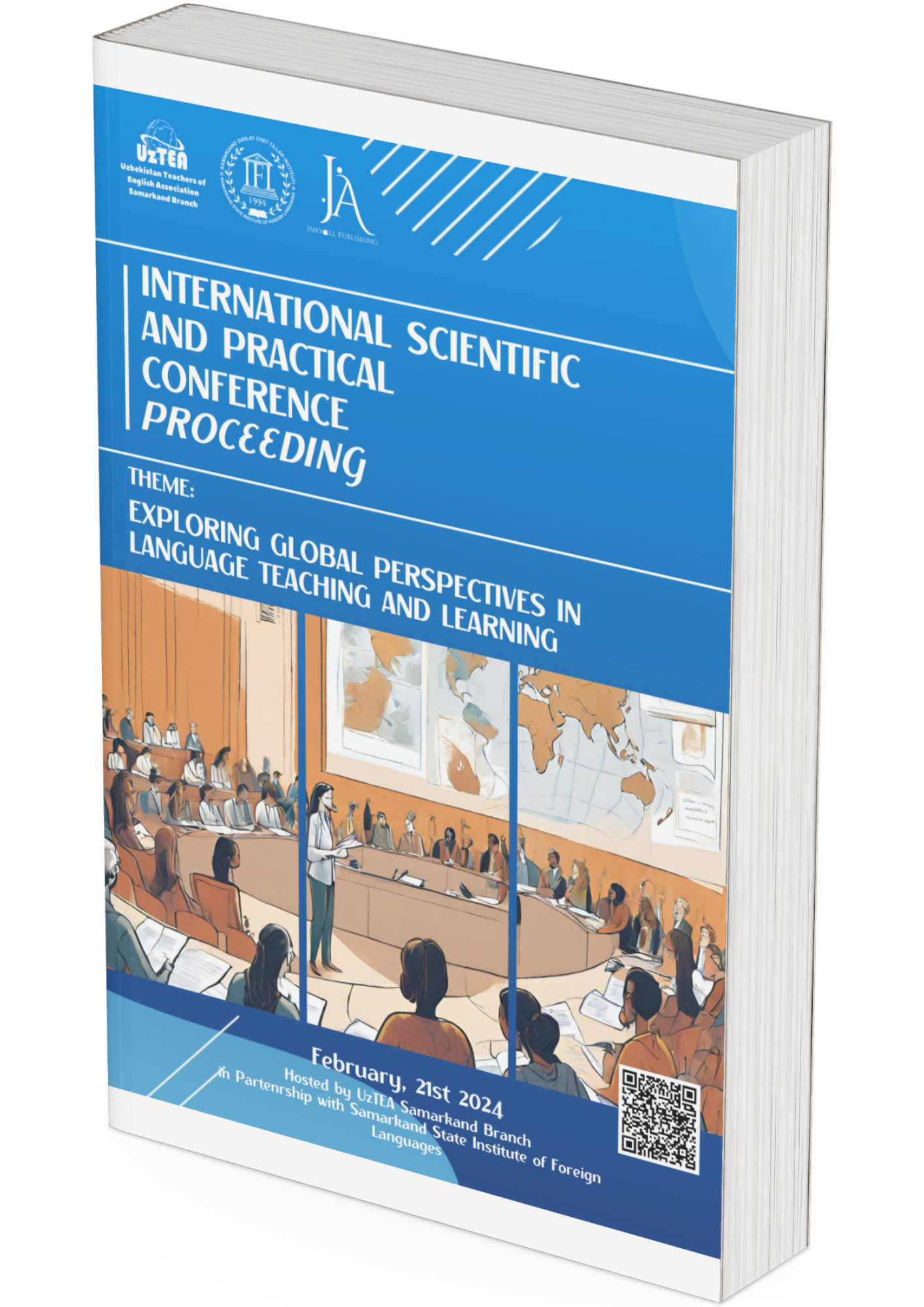
Conference Proceedings Volume
Section
License
Copyright (c) 2024 Mukhlisa Azizova, Guzal Rakhimova (Author)

This work is licensed under a Creative Commons Attribution 4.0 International License.
How to Cite